
HSK 3.0 Launches December 13, 2026: What Changes
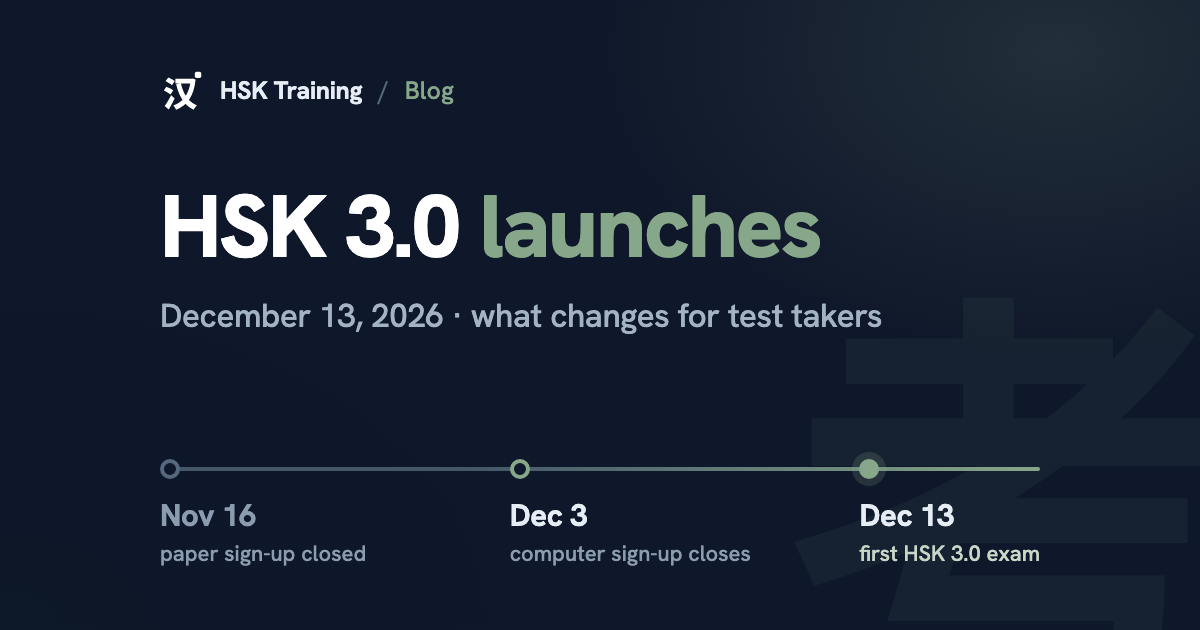
HSK 3.0 becomes the live exam on Sunday, December 13, 2026. Chinese Testing International (CTI), the company that runs the HSK, set the date in an official notice published on September 9. It is the first regular sitting of the new exam. The notice calls the launch worldwide. Japan is one exception we found, and it switches in January 2027.
If you plan to sit it, check the deadline first. Registration for the paper-based test closed on November 16. Registration for the computer-based test closes on December 3 at 24:00 Beijing time, which is 16:00 UTC the same day.
The notice is short. It gives the date, the two deadlines and where to register. For this post we also read CTI's test calendars for 2026 and 2027, the exam syllabus, the official sample papers and the notice for September's trial sitting. Here is what those documents say and what they leave open.
Dates and deadlines
| Milestone | Date |
|---|---|
| Test day | Sunday, December 13, 2026 |
| Paper-based registration | Closed on November 16, 2026 |
| Computer-based registration | Closes December 3, 2026 at 24:00 Beijing time |
| Results, computer-based test | December 28, 2026, and January 4, 2027 for the speaking test |
| Results, paper-based test | January 15, 2027 |
| Next sitting | Saturday, January 9, 2027 |
You register on chinesetest.cn, where you can also look up the test centres in your country. A centre can set an earlier deadline of its own, so confirm the date with yours. The result dates come from CTI's 2026 calendar.
If you miss December, the January 9 sitting takes paper-based registrations until December 13 and computer-based registrations until December 30. CTI's 2027 calendar lists eleven sittings for levels 1 to 6: January 9, March 14, April 10, May 16, June 26, July 18, August 21, September 12, October 16, November 7 and December 11. HSK 7-9 runs twice, on May 23 and November 20. The calendar gives two formats for every 2027 date, paper-based and computer-based at a test centre. Not every centre runs every date.
Wasn't HSK 3.0 due in July 2026?
July 2026 is the implementation date printed on the cover of the exam syllabus (a PDF in Chinese), which the Center for Language Education and Cooperation published in November 2025. The exam itself came later. CTI ran trial sittings during 2026, the second of them on September 20, and December 13 is the first sitting where HSK 3.0 is the official exam.
Is the old exam still offered?
The launch notice does not mention HSK 2.0, and the answer depends on where you sit the exam.
CTI's own pages point one way. Its 2027 calendar lists one HSK exam for levels 1 to 6, and its public test-date search shows one HSK entry for December 13 and for each 2027 date. The test centre at the London School of Economics writes that "From December 2026, all test centres will begin implementing HSK 3.0, and HSK 2.0 will no longer be offered."
Japan is an exception. The HSK Japan committee runs the exam there on its own calendar. It says (in Japanese) that every 2026 sitting in Japan stays on the old exam, December 13 included, and that HSK 3.0 starts with the January 2027 test. Its first 2027 date is January 23.
Ask your test centre which version it runs on your date. Unless it tells you otherwise, plan on the new exam from December 13 on.
What changes on the paper
The table compares the old papers, as CTI's level pages describe them, with the official HSK 3.0 sample papers. The sample pack is a 395 MB download that includes the audio. The last column is the new speaking test.
| Level | Old paper | HSK 3.0 paper | Speaking test |
|---|---|---|---|
| HSK 1 | 40 questions, 40 min | 40 questions, 40 min | None |
| HSK 2 | 60 questions, 55 min | 60 questions, 60 min | None |
| HSK 3 | 80 questions, 90 min | 70 questions, 83 min | 15 questions, 15 min |
| HSK 4 | 100 questions, 105 min | 70 questions, 85 min | 5 questions, 20 min |
| HSK 5 | 100 questions, 125 min | 72 questions, 110 min | 5 questions, 23 min |
| HSK 6 | 101 questions, 140 min | 82 questions, 125 min | 5 questions, 23 min |
From level 3 up, the written paper is shorter than before and a speaking test comes with it. Level by level:
- HSK 1 keeps its shape, with 20 listening and 20 reading questions.
- HSK 2 gains a writing section. Five questions ask which component completes a character, and five ask you to write the missing character of a sentence from its pinyin.
- HSK 3 ends with ten writing questions. You write five characters from pinyin and five sentences, each using a given word.
- HSK 4 drops from 100 questions to 70. Its writing section is five sentences, each built from a picture and a given word, and one short essay of at least 80 characters.
- HSK 5 has two writing tasks. One is a story of at least 100 characters told from four pictures. The other is an essay of at least 200 characters on a set topic.
- HSK 6 asks for a practical text of at least 150 characters and an essay of at least 300 characters. In the sample, the practical text is an ad for a flatmate.
- HSK 7-9 is one paper for all three levels. It has 91 questions in about 200 minutes and covers listening, reading, writing, translation and speaking.
The speaking test for levels 3 to 6
Under the old system, speaking was a separate exam, the HSKK, with elementary, intermediate and advanced tiers. HSK 3.0 has a speaking test for each level from 3 to 6, and the sample pack includes a paper for each one.
- HSK 3. Repeat eight sentences after hearing them, describe five pictures and answer two questions. About 15 minutes, six of them preparation time.
- HSK 4. Retell two passages after hearing them, describe one picture and answer two questions. About 20 minutes, ten of them preparation time.
- HSK 5 and HSK 6. The same three parts as HSK 4, with longer answers. About 23 minutes.
Do you have to take it? For September's trial sitting the answer was yes. The trial notice (in Chinese) required candidates at levels 3 to 6 to register for the written paper and the speaking test of the same level together. It set the fee for the pair equal to the old fee for that level's HSK plus the matching HSKK tier, and it left the fees for levels 1 and 2 unchanged.
The launch notice does not repeat that rule. On November 17, CTI's test-date search listed the new speaking test on the same dates as the written paper from December 13 on, and no upcoming sessions for the old HSKK.
Two organisers have told their own candidates that the pairing is not required. The LSE centre says the two parts do not have to be taken together, and it offers only the written paper. HSK Japan says the written and speaking tests can still be booked separately after the switch, and that each gets its own result.
Ask your test centre how registration works there before you pay. Ask the university, scholarship or employer that wants your result whether it needs a speaking score.
Vocabulary per level
The syllabus numbers its word list from 1 to 11,000 and gives the level of every word. Counted cumulatively:
| Level | Old exam | HSK 3.0 |
|---|---|---|
| HSK 1 | 150 | 300 |
| HSK 2 | 300 | 500 |
| HSK 3 | 600 | 1,000 |
| HSK 4 | 1,200 | 2,000 |
| HSK 5 | 2,500 | 3,600 |
| HSK 6 | 5,000+ | 5,400 |
| HSK 7-9 | No such level | 11,000 |
Level 1 doubles. Levels 2 to 4 grow by two thirds, level 5 by 44% and level 6 by about 8%. The old totals are the ones HSK Japan lists on its level page (in Japanese).
If you have seen 500, 1,272 and 2,245 words quoted for levels 1 to 3, those figures come from the 2021 grading standards. The exam syllabus sets the totals above.
The same document lists the grammar points, topics, tasks and characters for each level, including the characters you are expected to write by hand. Our comparison of HSK 3.0 and HSK 2.0 puts the two versions side by side.
Scores, pass marks and old certificates
- Validity. CTI's level pages state that an HSK result is valid for two years from the test date, and the trial notice gives HSK 3.0 score reports the same two years. The launch notice says nothing about results you already hold. Whether a university accepts an old-format result after December is the university's decision, so ask it.
- Pass marks. Neither notice gives a score scale or a pass mark for HSK 3.0, and the sample papers do not either. The old pass marks were 120 out of 200 at levels 1 and 2 and 180 out of 300 at levels 3 and 4. Do not assume they carry over.
- Conversion. We found no official table that converts an old level to a new one.
What to do now
- If you are registered for December 13, download the sample pack and sit the paper for your level against the clock. CTI also runs an online trial of the computer-based exam at hsk3demo.chinesetest.cn and hsk3demo-intl.chinesetest.cn.
- If you are not registered, you have until December 3 for a computer-based seat. After that the next sitting is January 9.
- If you are at level 3 or above, practise the speaking formats out loud. Repeat or retell what you hear, and describe a picture within a time limit.
- If your materials were made for the old exam, check them against the new word list. HSK 4 now covers 2,000 words instead of 1,200. From level 3 up, old mock papers have different question counts and different writing tasks.
- If you hold an old certificate, the two years of validity on CTI's pages run from your test date.
The practice items on HSK Training are generated against the new paper's structure, part by part, and the word lists are the syllabus lists, for example the HSK 3 words.
Not sure where you stand?
Take the free HSK level test — about 3 minutes, no account needed, scored against the HSK 3.0 levels.
Find your HSK level