
Spaced Repetition: How to Actually Remember HSK Vocabulary
The new HSK asks a lot of your memory: about 2,245 words by HSK 3, and 5,455 by HSK 6. At those numbers the bottleneck isn't finding time to study — it's that most of what you study quietly disappears. Psychologists have been measuring this since 1885: without review, new material decays on a steep, predictable curve, and much of it is gone within days.
Spaced repetition is the fix, and it fits in one sentence: review each word right before you'd forget it, at intervals that grow every time you recall it — minutes, then a day, then three days, then weeks. It is one of the most consistently replicated findings in learning research, and it's the engine behind the Learn section on HSK Training. Here's the science, and how to put it to work.
Your memory decays on a schedule
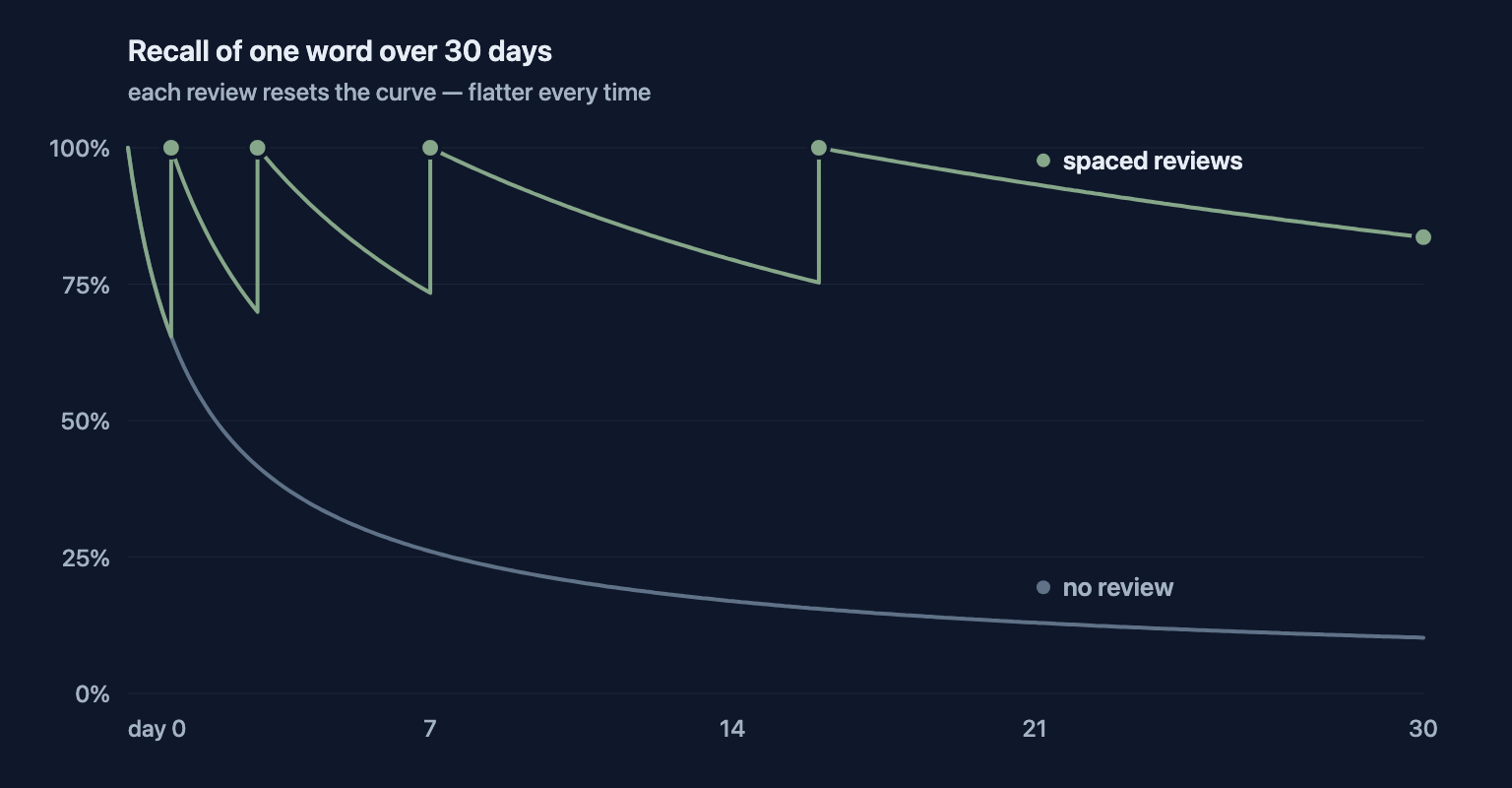
In 1885 Hermann Ebbinghaus taught himself thousands of nonsense syllables, tested his own recall at set delays, and drew the result: the forgetting curve. Retention drops fastest in the first hours and days, then levels off — an exponential decay. Learn twenty words tonight and, left alone, you'll have lost a large share of them before the weekend.
The useful part is what happens when you interrupt the curve. Each successful review resets retention to the top — and the curve that follows is flatter than the one before. Review a word a few times at the right moments and its forgetting curve ends up so flat that you only need to see it every few months.
Two effects do the heavy lifting
Spaced repetition works because it stacks two separate, well-documented effects.
The spacing effect: gaps beat repetition in bulk. A meta-analysis by Cepeda and colleagues covering 317 experiments found that practice separated by delays reliably beats the same amount of practice massed together — and that the longer you need to remember something, the longer the optimal gaps become. Seeing 便宜 today, tomorrow, in four days, and in two weeks beats seeing it eight times in one evening, with the same total effort.
The retrieval effect: being tested beats re-reading. In a well-known 2008 study, Karpicke and Roediger had students learn foreign vocabulary and then either repeatedly re-study the words or repeatedly test themselves on them. A week later, the tested group recalled about twice as much. The effortful moment where you stare at 便宜 and pull piányi — cheap out of memory before checking is not a way of measuring learning — it is the learning. Re-reading a word list skips exactly that step, which is why it feels productive and isn't.
A good system therefore does both: it always asks you (retrieval), and it asks at growing delays (spacing).
What a good schedule looks like
You can run spaced repetition with a box of paper flashcards, but the bookkeeping for thousands of words is exactly what software is for. Most modern systems descend from the SM-2 algorithm (SuperMemo, 1987 — the same lineage as Anki), and they all follow the same three rules:
- Recall it → the interval grows, typically by a factor around 2–2.5. One day becomes three, becomes a week, becomes weeks.
- Recall it instantly → it grows faster. Easy words get out of your way.
- Miss it → the interval shrinks and the word comes back soon. A miss isn't a failure of the system; it's the system finding the exact word that needed you.
How the Learn section runs this for you
The Learn section on HSK Training is a spaced-repetition system built specifically for the HSK 3.0 word lists, so you never manage a schedule or make a flashcard yourself. What it does with each word, concretely:
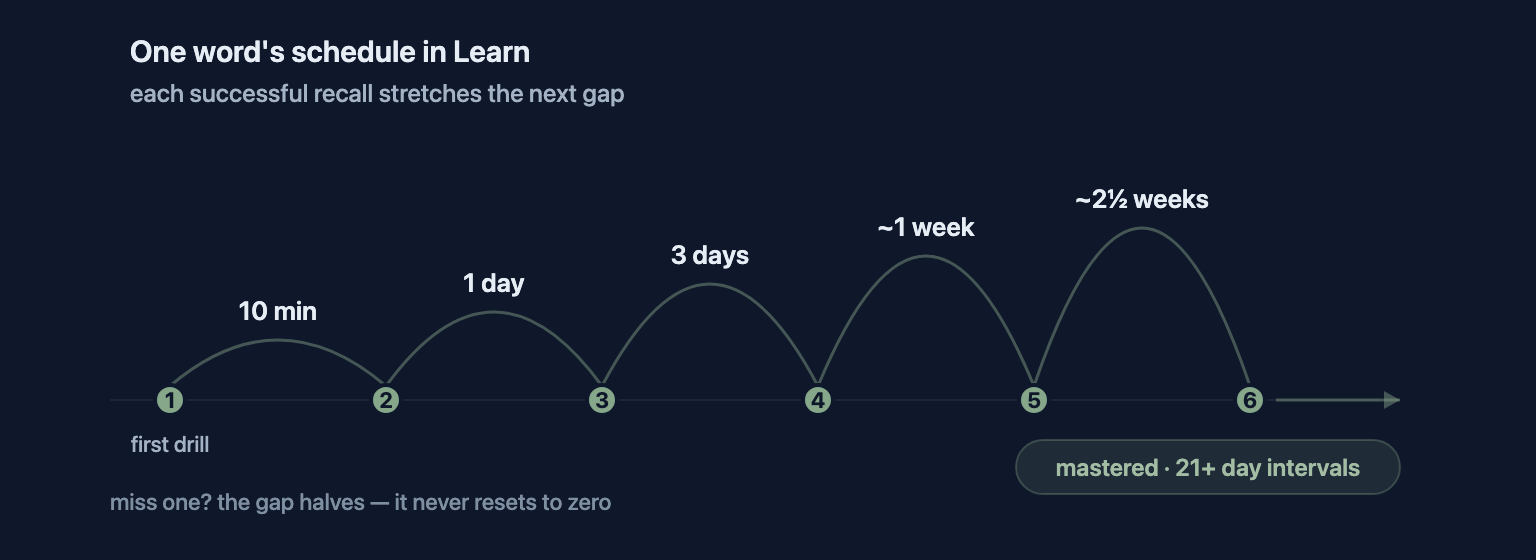
- New words start with short steps — a first drill, again about ten minutes later in the same session, then the next day. Only after that does a word graduate to a three-day interval and enter the long game.
- Every review is a real test, never a passive flip: choose the meaning, pick the hanzi for a spoken word, type the pinyin. Different drill types keep the retrieval honest — recognizing 便宜 in a list and producing its pinyin are different memories.
- Intervals stretch with each success — three days, a week, two and a half weeks, and onward. A word you recall at a three-week interval or longer is counted as mastered, which is why the mastered count is an honest "am I ready?" signal rather than a vanity number.
- A miss halves the interval instead of resetting it. Ten weeks of history doesn't vanish because you blanked once; the word steps back, proves itself, and re-graduates to where it was.
- Grammar rides the same schedule. Once a unit's words are done, its grammar patterns join the queue as cards and cloze drills, and short checkpoints confirm a whole unit before you move on.
- Exam practice feeds back in. Miss a word inside a listening or reading exercise in the Practice section, and the scheduler hears about it — the word moves up your review queue. Drills test you; Learn teaches you.
The daily session assembles itself from whatever is due plus a small budget of new words. On the free plan that's up to 5 new words a day — reviews are always unlimited, because skipping due reviews is the one thing a spaced-repetition system can't absorb.
Using it well
The method needs consistency more than talent. Four habits make the difference:
- Show up daily, briefly. The spacing lives between days — ten minutes every day beats seventy minutes on Sunday, at identical total effort. This is also why the session is designed to fit in a few minutes.
- Answer before you reveal. Commit to a guess, even a wrong one. The retrieval attempt is the work; checking is just feedback.
- Welcome the misses. Around one review in ten should fail — that's the schedule probing the edge of your memory, which is where it's most efficient.
- Keep new words modest and steady. Every new word becomes future reviews. A steady handful per day compounds into a clear queue and a rising mastered count; a binge becomes next week's backlog.
None of this is a trick — it's just your memory's actual maintenance schedule, run by software instead of willpower. Start a few minutes a day now, and by exam day the words won't need cramming, because they never got the chance to fade.