
The Daily Episode: One HSK Lesson a Day
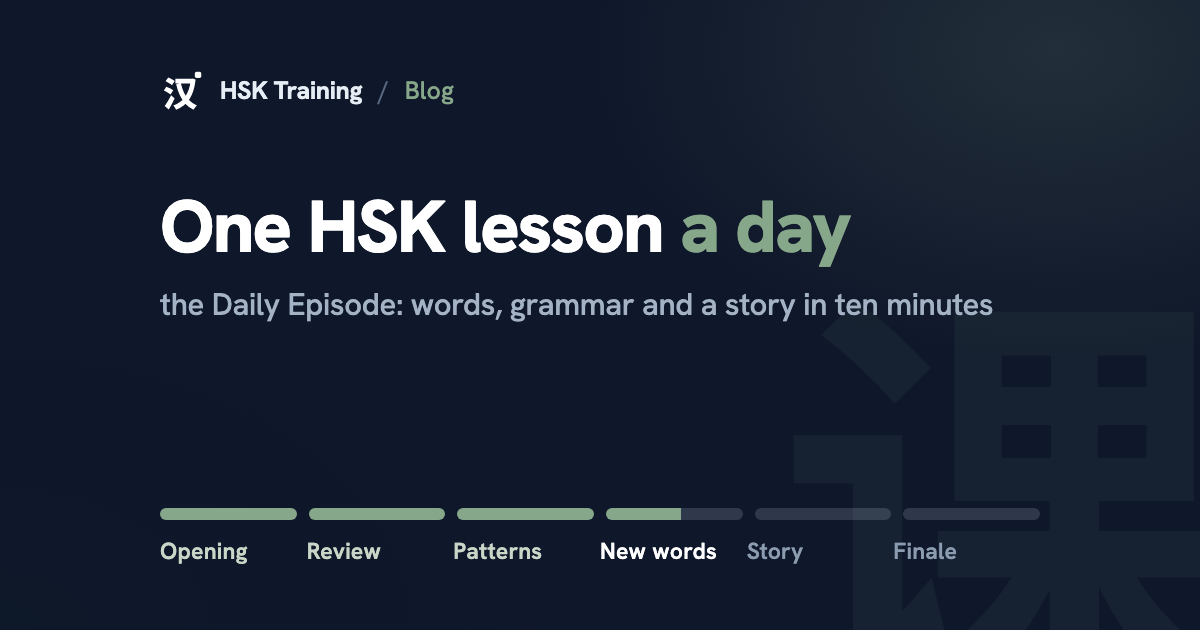
The Learn section on HSK Training started as a review queue: open it, drill whatever was due, add a few new words, close it. It worked, and the spaced-repetition engine underneath has not changed. What changed is the shape of a day. Learn is now the Daily Episode: one lesson per day with a fixed order, the same on the web and in the iOS and Android apps, that takes about ten minutes on a typical day and ends with a recap.
This post walks through what an episode contains, how it teaches vocabulary and grammar, and what to expect once you make it a habit.
What an episode looks like
Every episode runs the same six segments in the same order. Each one exists for a reason, and none of them is a passive flip.
- Opening. Most days you meet one new grammar pattern from your current unit: the pattern, what it means, and example sentences with pinyin and audio. Tap "Got it" and the pattern enters your review schedule. One day in three the opening is a tongue twister instead, with audio at slow, normal and fast speed. Say it out loud. Pronunciation is the part of Chinese that drills alone never fix.
- Review. Up to 14 words that are due today, each as a real test: choose the meaning, pick the hanzi for a spoken word, fill the gap in a sentence, or type the pinyin. The format rotates per word, so the schedule never lets you recognize a word the same way twice in a row.
- Pattern reviews. Up to four grammar points that are due, drilled the same way the words are. A pattern you met recently gets a meaning question. One you have seen a few times gets a cloze sentence to complete.
- New words. A short presentation card per word (hanzi, pinyin, meaning, audio, an example sentence), then the word goes into the schedule. Already know it? "I know this" skips the first days and puts it a week out, where a review will confirm it.
- Story. A short reader at your level or one below, ranked by how many of your words it contains. It can be a story, a chengyu tale, a riddle or a short grammar text. Today's new and reviewed words are highlighted, every word has the hover dictionary, and every reader comes with audio. The recap counts how many of today's words you met in it. The library is still small, so on a day with nothing unread at your level the episode skips straight to the finale.
- Finale. Four of today's words with harder distractors than the reviews used. The last question is worth double. Then the recap: reviews correct, pattern reviews correct, new words started, words met in the story, finale score, and the list of anything you missed.
Finishing the episode is the daily goal. Your streak extends when you finish, whatever the XP count says, and anything you do after that is bonus.
How it teaches vocabulary
The engine is the same SM-2+ scheduler the Learn section has always run, so the rules from the spaced repetition post still hold:
- A new word comes back after about ten minutes, then a day, then three days, and the gap grows with every correct answer. A word you recall at a three-week gap or longer counts as mastered.
- A miss halves the interval instead of resetting it. The word steps back, proves itself, and climbs again.
- Ratings are never self-assessed. The drill is graded, and the time you took decides whether a correct answer was "hard", "good" or "easy". Twelve seconds is the limit for a meaning choice, twenty-five for typed pinyin.
What the episode adds is context on the same day. The new words you start in segment four are the ones highlighted in the story in segment five and quizzed in the finale in segment six. Three retrievals of a word within ten minutes, each in a different form, is the first rung of the schedule done well instead of done once.
The words themselves come from the official HSK 3.0 list for your level, split into themed units of about twenty words. Example sentences for a unit are checked against the vocabulary you have already learned, so a sentence never leans on a word you have not met. Twenty questions close each unit as a checkpoint. Score 80% and the next unit opens.
Two more places feed the same schedule. Miss a word inside a listening or reading exercise in the Practice section and the scheduler moves it up your queue. Save a word from the Chrome extension while reading online and it joins the queue too.
How it teaches grammar
Grammar used to wait until a unit's words were done, and it only showed up in the old session. Now it has a slot in every episode.
- One pattern most days. The opening serves the next untaught pattern from the units you have passed, then from the unit you are on. Every unit from HSK 1 to HSK 4 carries one or two grammar points, so the openings keep pace with the words.
- Patterns come back for review. Each pattern you tap "Got it" on gets a row in the same spaced-repetition schedule as your words. When it comes due, the pattern reviews segment asks for its meaning, and later for a cloze sentence that uses it.
- Near-synonyms get their own drill. For the pairs learners mix up, the drill shows a sentence and asks which word fits. The curriculum carries about 300 of these comparison points, most of them at HSK 4 and above: 二 and 两 at HSK 1, 突然 and 忽然 at HSK 4, 肯定, 确定 and 一定 at HSK 5.
What to expect day to day
Time. With 14 reviews and the default five new words, the hub card estimates about eight minutes of drills. Reading the story adds a couple more. A day with few reviews is shorter.
New words per day. Your daily goal sets the pace: a 20 XP goal starts two new words a day, 50 XP starts five, 100 XP starts ten. Reviews are never capped by the goal.
Backlog after a break. Come back after two weeks and you will not see "217 due". A nightly job spreads the overflow over the next few days, the episode keeps its 14-word review segment, and the done card tells you how many words the schedule still owes. "Extra practice" after the episode works through those first, as real reviews.
Streaks and freezes. The streak is shared between Learn and Practice, and a day counts with either. Every seventh consecutive day you meet the goal earns a streak freeze, up to two banked, so one missed day does not erase a month.
Milestones. Your profile marks 100, 500 and 1,000 words learned, 50 words mastered, and streaks of 7, 30, 100 and 365 days.
Across devices. The episode is one plan per day. Your position is derived from what you have answered, not from the tab you opened, so closing the app mid-review and reopening on the web lands on the same step. Nothing is answered twice.
What is next
Every review is logged with its rating and response time, which is the data needed to fit a per-learner schedule (FSRS) instead of the fixed SM-2+ intervals. That is the next step for the scheduler. On the content side, the story segment draws from a growing reader library, and the Chrome extension is on its way to scoring any web page by how much of it you can already read. If you have an opinion on what the episode should do next, write to us.
Bạn chưa rõ mình đang ở đâu?
Làm bài kiểm tra trình độ HSK miễn phí — khoảng 3 phút, không cần tài khoản, chấm theo các cấp độ HSK 3.0.
Tìm cấp độ HSK của bạn